
Athens County Arrest Reports
Neither ACSO nor SEORJ publishes a multi-day arrest blotter. The official-linked SEORJ roster is a live regional custody view, not a seven-day archive. For narrative coverage, The Post Crime/Cops section is the strongest local secondary source. Its weekly-style blotters and crime stories cover the Athens County Sheriff, Athens Police, Ohio University Police, warrants, and more.
One ACSO article ran August 24, 2026. It summarized entries from August 14 through 20. That is a single example, not a schedule. It guarantees no fixed publication day, no seven-day window, and no complete list. Editors can skip calls, arrests, bookings, or whole agencies. For a named event, confirm against the roster, the agency record, and the court docket.
Read Athens Police Blotters
Check the event dates inside an item, not just its publication date. One article can span several days. Then name the agency and separate a call for service, a warrant reference, an arrest, and an actual SEORJ booking. News prose is not the underlying report.
- Open the Crime/Cops index and locate an article tied to the relevant agency or date range.
- Record the article date and every incident date stated in the text.
- Note attribution, such as ACSO, Athens Police, OUPD, Nelsonville Police, or another office.
- Check the current SEORJ roster when custody is still likely, filtering by Arresting Agency.
- Request the official incident or booking record for full, durable documentation.
For fresher activity, Arrested Today is the tool. It explains why the roster timestamp and book date still do not add up to an official 24-hour feed.
Athens Arrest Report Fields
A news blotter entry and a jail row carry different fields. Keep them apart. Never merge them into one invented record. Quote or paraphrase each source with clear attribution, and preserve uncertainty when a fact is missing.
| Element | How it may appear |
|---|---|
| Event date | The date described in an article, which can differ from publication date. |
| Agency | The office supplying or handling the reported event. |
| Incident narrative | An editorial summary, not the full official report. |
| Arrest or warrant reference | An charge or enforcement action requiring official confirmation. |
| Book Date | A roster field showing when SEORJ recorded a booking. |
| Charges | Accusations as displayed at the booking stage. |
| Current Disposition | A jail custody label, not the court’s final outcome. |
| Photo | A roster image when supplied; news pages are not a booking-photo roster. |
A police narrative can include events that never led to a jail booking. The reverse happens too. A roster row can lack any news story. Use the agency case number to request the exact record.
The Post Athens Blotter
The Crime/Cops section's index displays the recurring local news format and counts as secondary coverage.
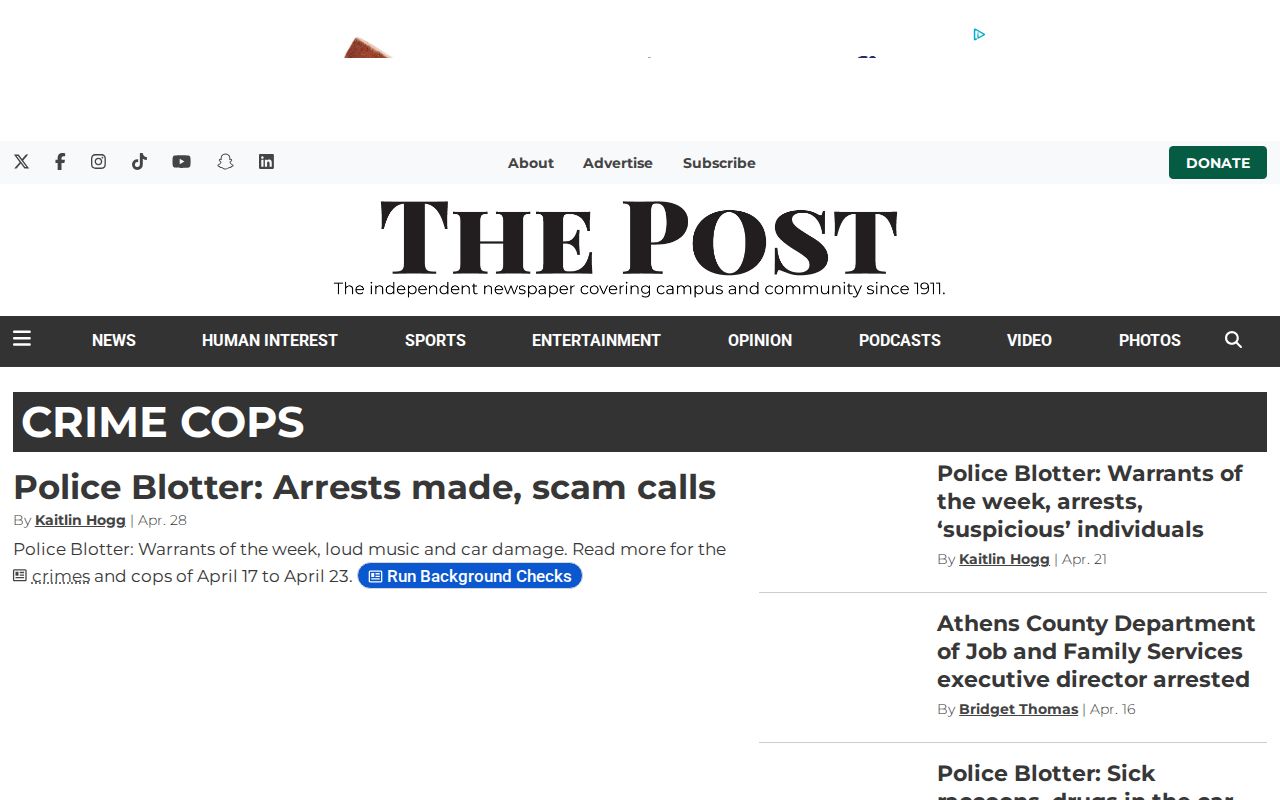
The section index helps you spot the coverage. It does not show every Athens County arrest, and its news images are not booking photographs.
Athens Weekend Report Gaps
No official rule covers weekend or holiday publication. A weekend arrest can land on the regional roster. It can surface later in a weekly story. Or it may surface only through the agency and court. Delay is not proof that nothing happened. A burst of items in one article does not mean crime rose.
Ohio University and Hocking College swell Athens County each academic year. That mix pulls city, county, campus, and regional agencies into one blotter. It still proves no trend. Trend claims need a defined dataset, steady agency coverage, and comparable time periods. Article counts and roster rows fall short.
Note: Treat dates, agencies, and source windows as separate facts, especially when a weekday article summarizes weekend events.
Archive Athens Arrest Records
The visible roster promises no historical archive. A news index has editorial limits too. Older official material starts with the ACSO Records Unit or the agency that wrote the report. Give the incident type, location, person, case number, and approximate date range when you can. Ask whether the record stayed with the office, was transferred, was redacted or sealed, or was disposed under the governing schedule.
ACSO follows county RC-2 retention schedules. No public material lists a booking-photo-specific period. Records may be inspected and copied at actual cost. Redaction applies where law requires it. Ask for the current RC-2 series and disposition status instead of borrowing another county's schedule.
If ACSO transferred older material, ask where. Get any accession, box, or series reference. The Ohio History Connection's Local Government Records Program notes that local records may stay local or move to an archive, historical society, or library. No complete State Archives index of Athens County booking photographs exists.
Request Athens Arrest Reports
A precise request saves everyone time. Name the agency that created the incident report or booking record. Give a date range. Add a case number if you have one. For a booking, ask for the book date and time, arresting agency, charges as booked, jail identifier, bail, court details, and any legally releasable photo. The office does not have to build a new database or answer a research question.
- First ask the arresting police agency for its incident or arrest report.
- Ask ACSO Records for sheriff-created records and its current retention status.
- Ask SEORJ about present prisoner information and jail-maintained material.
- Use Municipal or Common Pleas dockets for later case action.
- Document any stated transfer so an archive inquiry reaches the right repository.
Released people can vanish from the active jail view. The agency record still exists. A sentenced Ohio prisoner shows up in the ODRC search, not the county roster, so never collapse these custody stages into one arrest log.
News Versus Athens Records
News coverage serves a different purpose than county records. A story can explain what happened during an arrest and keep a public account alive after a jail roster changes. Coverage is selective, though. Check the article date and the sources a reporter names. Athens Ohio Today offers local news leads, but it carries no dedicated arrest section. The Athens News publishes no exact blotter section either, so treat neither as a complete feed of Athens County arrests.
Commercial booking aggregators are left out here. Those sites answer to vendors, not to Athens County, and their listings can sit stale, repeat entries, or attach the wrong name to a booking photo. They never replace ACSO, SEORJ, court, or police records. A vendor's claimed time window tells you nothing about the county's official archive.
Athens News Archive Limits
A newspaper home page is not a retention system. It can point you toward older coverage, nothing more. Search with the agency name, the date, the location, and the type of incident. Once you find an article, save its URL, publication date, byline, and the dates of the events it covers. A missing result never means no arrest occurred. The Athens Ohio Today home page serves only as a possible local-news starting point, not as an arrest archive for Athens County.

When a story disappears, go back to the agency that wrote the report. Newsrooms and government offices follow different rules. A paper can pull, reshuffle, or correct its pages at will. Police answer to records schedules and disclosure law. Court dockets add their own timeline. Keep the sources separate. An old headline then cannot be mistaken for current custody or a final result. Athens County reports can involve sheriff deputies, city police, campus police, and regional jail staff. So attribution stays attached to every fact. One agency's summary cannot fill in booking fields held by another. Where a complete account matters, request each source's own record.
Follow Athens Court Outcomes
Booking is only the first step. Athens Municipal and Common Pleas dockets can later show an arraignment, a formal case number, amended charges, bond orders, pleas, dismissals, trial results, sentences, or appeals. Never match a court entry by name alone. Use the case number, the date, and other non-sensitive context instead.
- Arraignment
- An early hearing where charges and rights are addressed.
- Bond
- A court condition governing release while a case proceeds.
- Disposition
- The result or procedural outcome recorded by the court.
- Expungement
- A statutory legal process affecting an eligible official record.
A roster's Current Disposition is not a final court disposition. That gap matters whenever arrest reports stretch across several days.